
AI, Molecular Modeling and Renewable Energy: Toward Revolutionary Materials

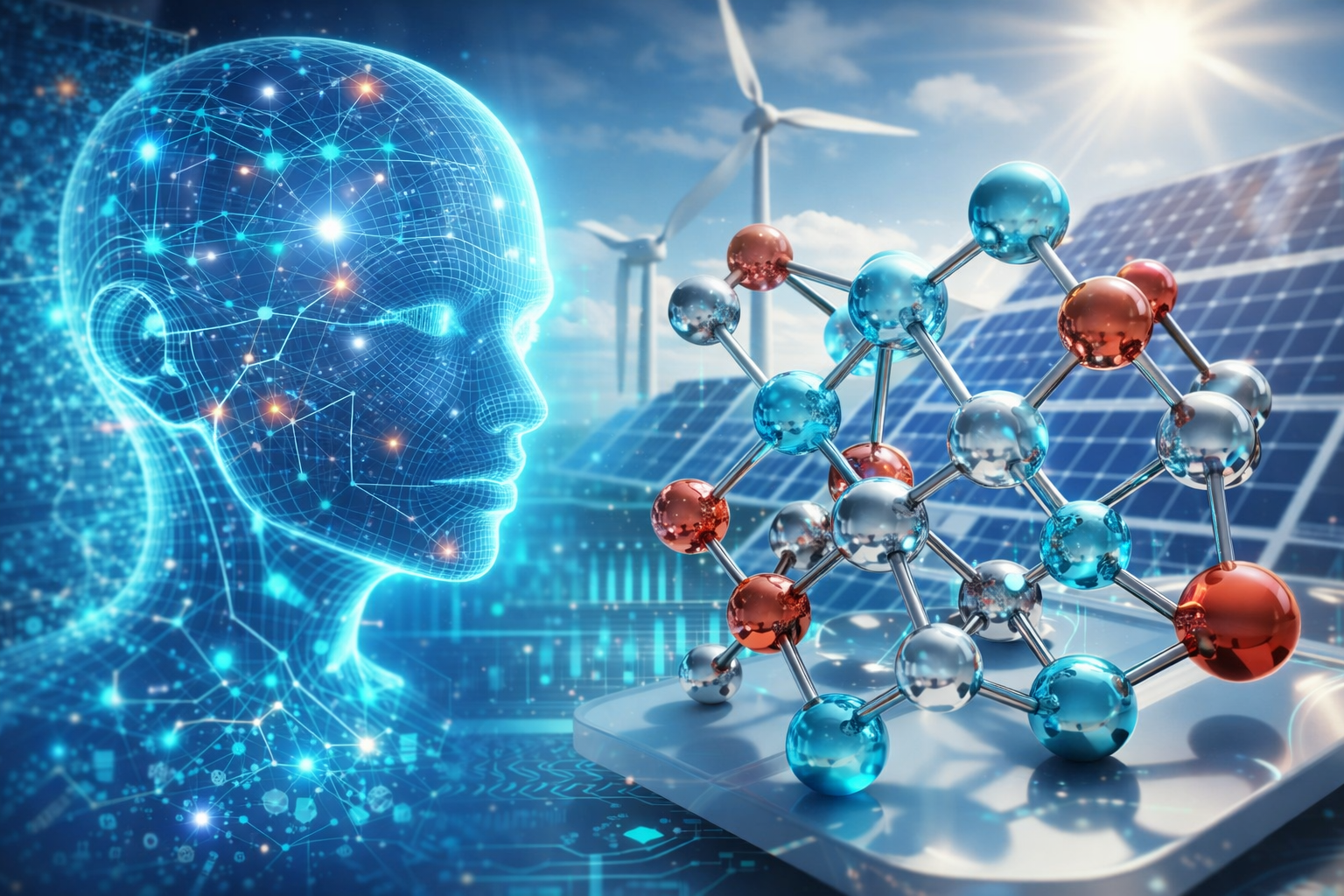
Artificial intelligence (AI) and molecular modeling are coming together to open promising new avenues in the field of renewable energy. By enabling the design of more efficient materials, these technologies are helping drive the energy transition and the fight against climate change.
Artificial intelligence (AI) is revolutionizing numerous sectors, and renewable energy is no exception. The combination of AI and molecular modeling is opening promising new pathways in the energy sector. By enabling the development of more efficient materials, these technologies can contribute to the energy transition and efforts to combat climate change. AI also plays a crucial role in optimizing the production, distribution and consumption of renewable energy.
Understanding Molecular Interactions
Molecular modeling relies on computer simulations to reproduce the behavior of atoms and molecules. By exploring interactions at the nanoscale, researchers can identify optimal structures and properties for specific materials. Molecular modeling goes beyond simply identifying these properties: it can also be used to improve existing materials or simulate—and potentially help develop—entirely new ones.
AI Can Accelerate Materials Discovery
AI now offers tremendous potential to accelerate discovery processes across a wide range of fields. By analyzing vast datasets and identifying patterns, machine-learning algorithms can suggest novel materials with specific properties tailored to the needs of renewable energy in particular contexts.
The following is a non-exhaustive list of concrete applications in renewable energy:
- More efficient solar panels: Molecular modeling can help design new materials for photovoltaic cells, increasing their efficiency.
- Higher-performance batteries: New materials for battery electrodes—conductive components that enable the flow of electric current—and electrolytes—substances that form electrically conductive solutions when dissolved in water—can improve energy-storage capacity and battery lifespan.
- Clean hydrogen production: AI and molecular modeling can help optimize the catalysts used to produce hydrogen through electrolysis, a technique that uses an electric current to split a chemical compound. Clean hydrogen is considered a promising energy carrier for the renewable-energy transition.
- Renewable energy storage: Innovative materials can be designed to store energy generated by intermittent renewable sources, such as solar and wind power, and release it when needed.
- Energy production forecasting: AI can be used to predict wind and solar power generation by analyzing weather data and other variables. This allows electricity-grid operators to better balance supply and demand while reducing the risk of overloads and power outages.
- Optimizing renewable-energy facilities: AI can improve the performance of renewable-energy installations. For example, it can help identify defective solar panels or adjust wind turbines to capture stronger winds.
- Integrating renewables into power grids: AI can facilitate the integration of renewable energy into existing electricity networks, helping maintain grid stability while maximizing the amount of renewable electricity that can be fed into the system.
Beyond these applications, AI and molecular modeling can also be used to design more efficient materials for biofuels, develop carbon capture and storage technologies, and improve the efficiency of wind turbines and hydropower systems.
Increased renewable-energy production, lower costs, improved grid reliability and reduced greenhouse-gas emissions broadly summarize the potential benefits of using AI in this sector.
Challenges and Limitations
However, the use of AI in the public sector also presents significant challenges, some of which have been identified by researchers at Université Laval in Canada.
- Implementation: Successfully integrating AI requires balancing security, quality, financial feasibility and the expertise needed for effective deployment.
- Legislation and regulation: AI regulation must address the governance of autonomous intelligent systems, accountability and responsibility, as well as the protection of personal data. The challenge is to ensure the responsible development and use of AI while protecting individual rights and freedoms.
- Ethical and social challenges: The use of AI raises questions about the value placed on human work and capabilities. These include the substitution and transformation of jobs, public acceptance and trust in AI, and changes in human-machine and machine-machine interactions.
Toward a More Sustainable Energy Future
AI and molecular modeling represent major assets in the development of innovative materials for renewable energy. By stimulating innovation and accelerating the discovery of higher-performance materials, these technologies can contribute to a cleaner and more sustainable energy future.
AI has the potential to transform the renewable-energy sector and support the fight against climate change. Despite the challenges involved, it remains a powerful tool that could play a crucial role in the energy transition.
Ultimately, the future of AI will depend on finding the right balance between humans and machines—one that takes into account cost, performance, quality, human values and ethics.